6m: The ARRL VHF June 2012 QSO Party
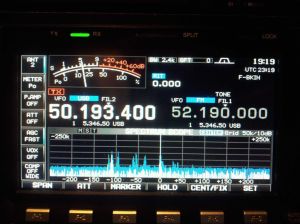
Sunday I had a chance to work a bunch of stations on 6m. I only have a vertical antenna, but that didn’t seem to matter much. I was able to work several stations that were participating in the ARRL VHF June 2012 QSO Party.
I haven’t worked very many stations on that band before, so this was a nice opportunity to work other stations on 6m. The 6 meter band is nice because it is so quite compared to other amateur bands.
Sunday afternoon, my friend Jeff N9IZ told me about the QSO party and that 6m was on fire.
Overall I made 24 different contacts on 6m. All these stations were participating the contest even though I really was not. I did exchange my grid locator number so that the contact with me would count on their log. Most stations I contacted seemed to be to the west in Colorado, or to the east in New Hampshire and Connecticut for some reason.
I believe that the upcoming storm may have changed some of the air temperatures creating Tropospheric ducting. This type of propagation makes it possible to communicate with stations way beyond the horizon.
I spent several hours playing on 6m, and at times I really needed to be patient to get the contact, but in the end it payed off nicely.
I had a great time and will participate again!
73 de Nick N9SJA
iPortable – My Portable HF station
This afternoon I finished with my iPortable – Portable HF station build. I purchased one of the iPortable Pro boxes from the vendor at the Dayton Hamvention. This write-up will be somewhat a review of the product as well as documentation about my particular installation.
The boxes look really nice. They have a matte black finish on them that really looks great.
Here are the features of the iPortable Pro:
- A nice sounding front facing speaker.
- A 1/4 inch headphone jack (that also disconnects the front facing speaker).
- A red LED indicating power.
- Anderson Powerpole connectors for connecting optional devices to the power supply.
- A cigarette lighter power receptacle for external devices (10 Amps max).
- 2 USB power ports (for connecting devices that charge or power via USB connections).
- Fuses for all of the ports to protect devices.
I installed the following equipment in the box:
- Icom IC-7000 HF/VHF/UHF Transceiver
- LDG IT-100 Auto Tuner
- Jetstream variable voltage switching power supply.
- Diamond Duplexer for HF/VHF-UHF
Here are some pictures (click for larger view):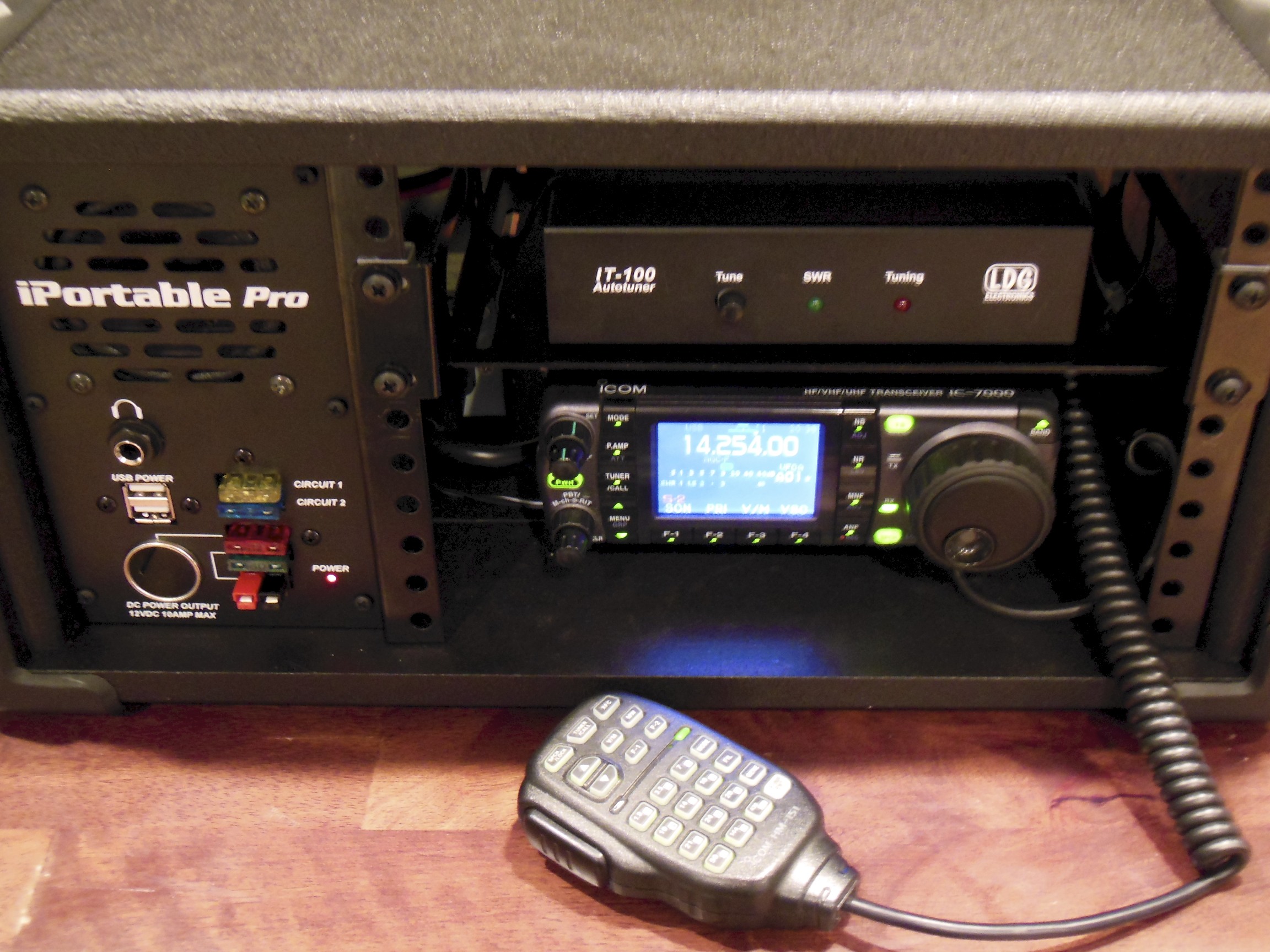
iPortable Pro – Front
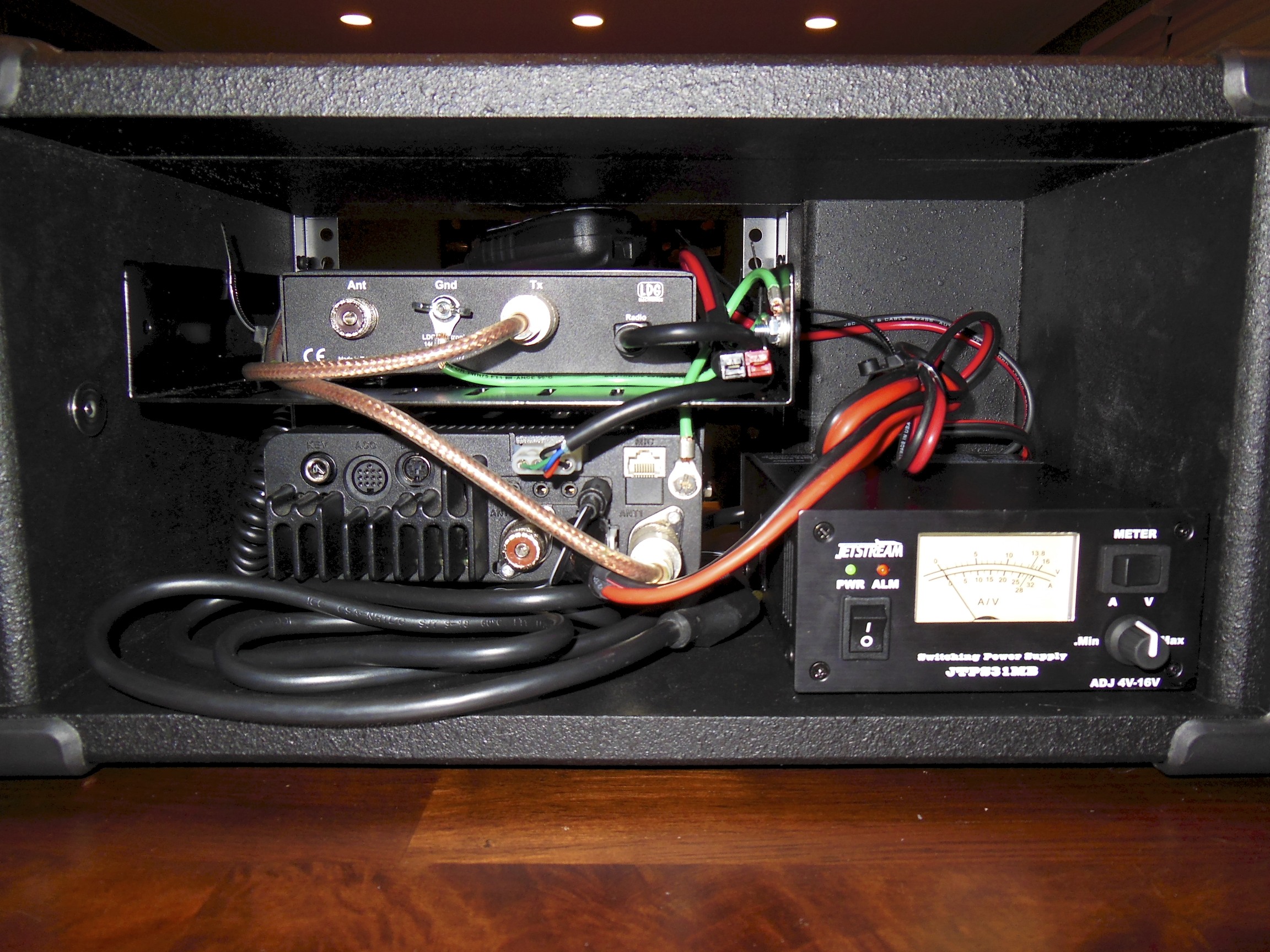
iPortable Pro – Rear
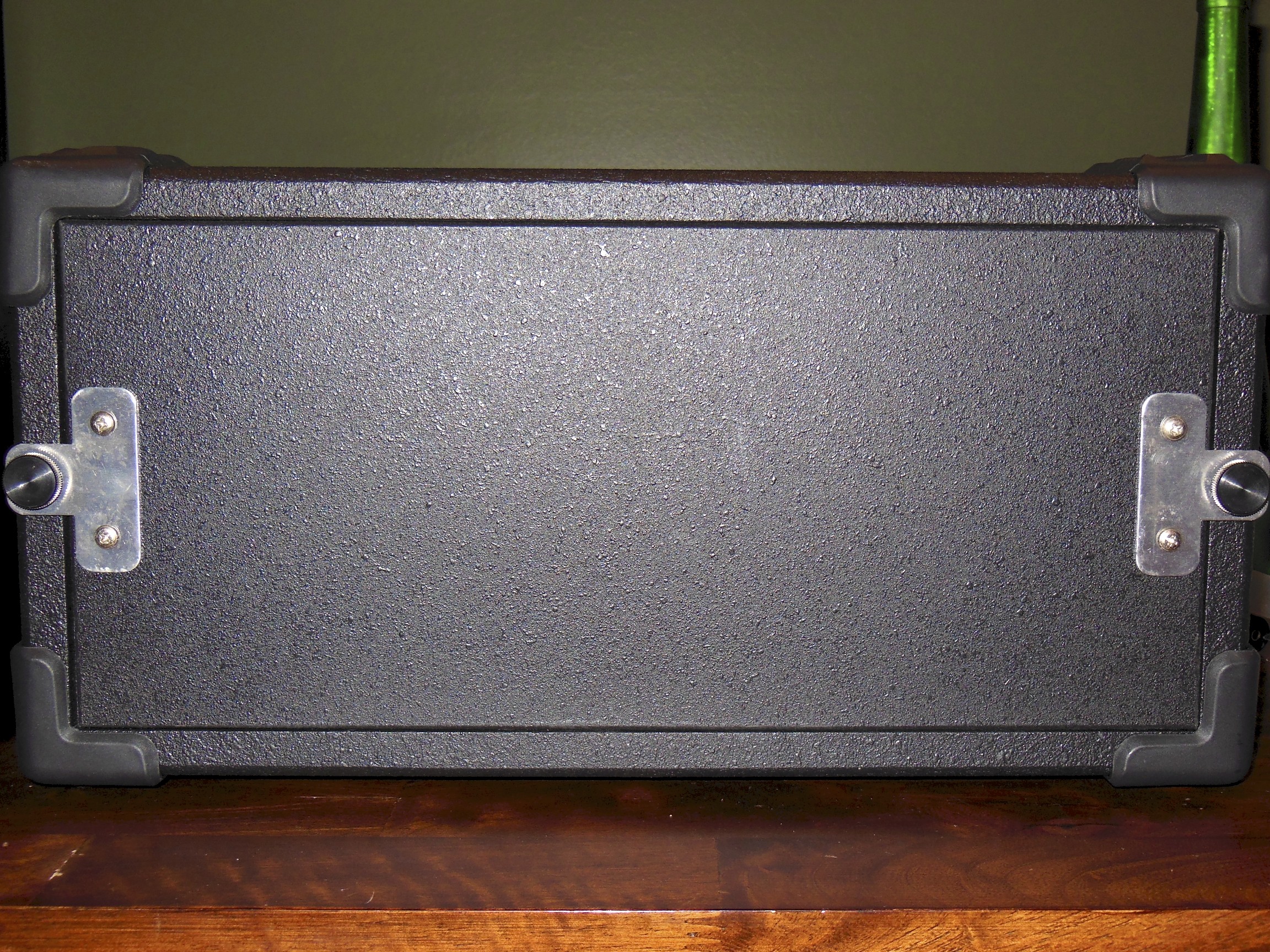
iPortable Pro – With Covers On
Pretty nice eh?
Well now for the review…I found the construction of this box to be somewhat flimsy. It is made of particle board type wood. It will not take an impact very well, and water might not be good for it (although I suspect the matte paint will give it some protection). The mounting hardware is not as good as other boxes that are used in the music industry. For durability, I would recommend one of those instead. The box is somewhat too small to mount the equipment that you really want to put in it. I found it a great challenge to fit everything inside well. The power supply was in particularly difficult for me to fit inside well.
My friend Jeff N9IZ, has a portable setup with a Gator portable AV enclosure which I think is of better quality. It is larger and has better construction, but lacks the nice plate with the front speaker, all the jacks and that kind of stuff. However I think perhaps one could be fabricated my a skilled metal worker, or a metal worker shop.
Over all I give the iPortable Pro enclosure a 3 out of 5 stars. It has some shortcomings, but looks great and has lots of features.
Tell me what you think in the comments!
73! de Nick N9SJA
Dayton Hamvention 2012
 My friends and I just got back from spending the weekend at another awesome Dayton Hamvention! This year I spent most of my time out in the flea market area, as I was a vendor with a booth outside. I had a few things to sell, like a Kenwood TM-D700 dual band transceiver, an old Astron 12V power supply, and a few other trinkets.
I did really well and sold just about everything that I came to Dayton with, to add a few bucks back in my pocket. I then turned right around and spent them at the other vendors at Hamvention. 🙂
Accompaning me this year was Craig KB9JDW, Dave KF9IZ, and Jeff N9IZ. We had a blast at Dayton.
Friday evening we setup a small HF station in the parking lot of our hotel and even made a few DX contacts! Jonas LY5A in Lithuania heard us loud and clear from the parking lot, as well as a Brazilian station. Operating outside was fun, we sat around in camp chairs and took turns operating.
The next day, I took a good walk around the flea market area and went inside as well.
There was a whole estate sale not far from where we had our booth setup, this guy had TONS of Collins and Heathkit stuff. I almost walked away with a complete KWM2A station, but resisted the temptation of doing so. I really do not need to buy more HF rigs, I already have too many of them that I rarely use the ones I have. I got a feeling that some of them will have to get sold next Hamvention. 😦
There were several new radios making news at Hamvention this year:
1. FlexRadio Systems – Flex 6000 series. Ooooh how I want one! I think this will be my next major radio purchase!
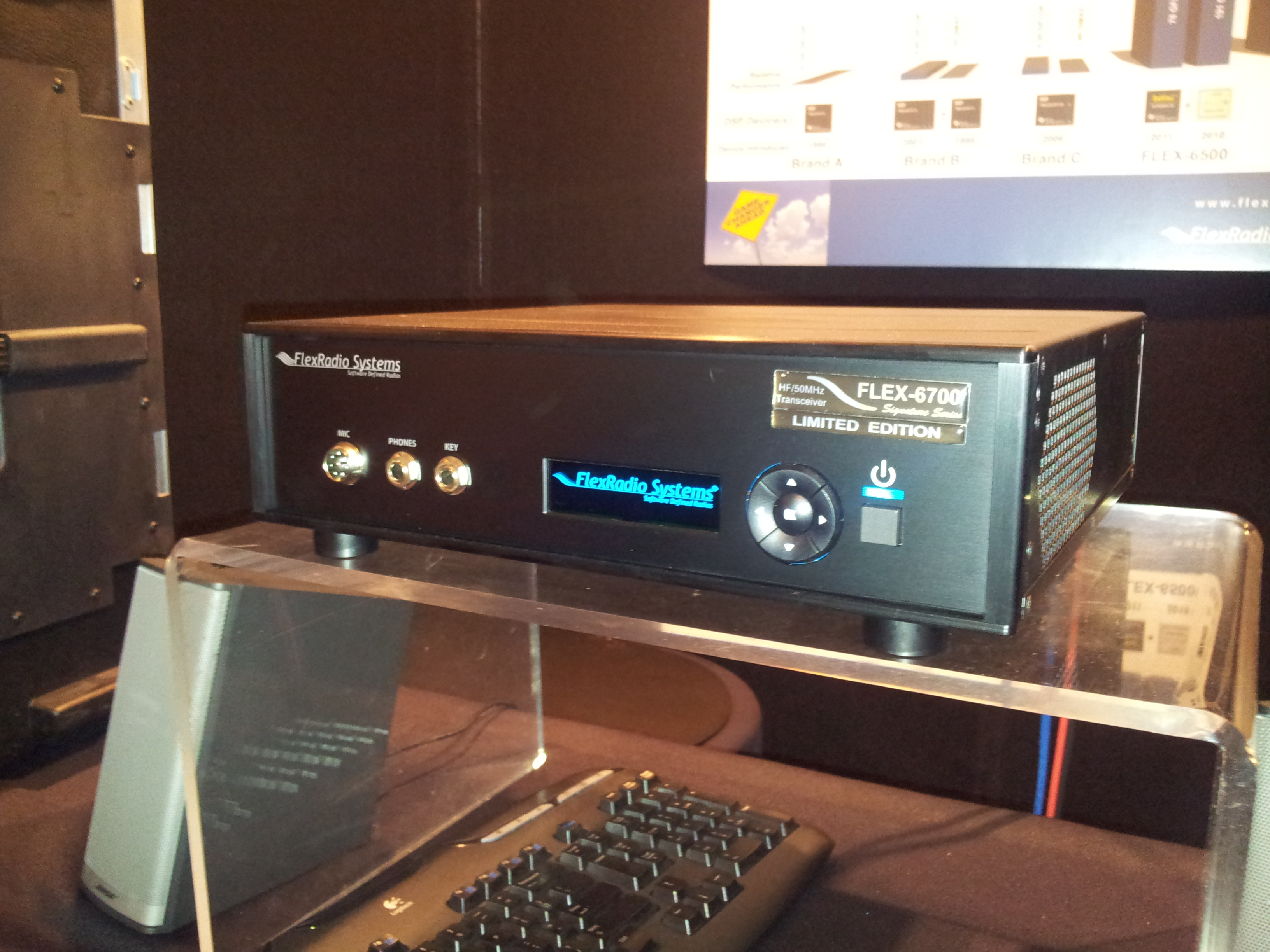 FlexRadio Systems – Flex 6700
2. Kenwood – Kenwood TS-990S. Very well done by Kenwood. It was only visible thought a plastic clear cube case, I wanted to twist the knobs and push the buttons! Kenwood says that the price is $5000 – $10,000. But I bet it will be right about $6500. That would make it competitive to the Icom IC-7700. It is very close in design to an IC-7700.
3. Yaesu – FT1D. Yaesu’s first foray into digital. Of course it is not D-STAR compatible. Yaesu uses new FDMA C4FM digital protocol. It will be interesting to see what happens with this! No pricing info as of yet.
 Yaesu FT-1DR/E Digital H.T.
4. Yaesu – FTDx 3000. Another offering in the mid-range class of HF transceivers. Very comparable to an Icom IC-7600 I would say. Again, no pricing as of yet. This radio was also encased in a big plastic cube, so I did not get to twist knobs or push buttons. 😦

As for me and my homies, we each walked away with a good haul of ham radio goodies:
Craig KB9JDW – Awesome iPortable Pro case. He is building a completely portable HF setup with this case. He also purchased a small LDG IT-100 automatic antenna tuner to put in the case. He plans on installing his Icom IC-706MK2G HF/VHF/UHF transceiver in the case. It will be very cool.
 iPortable Pro go-box that Craig and I both bought.
Jeff N9IZ – Purchased a fully portable go-box system. The system had a Yeasu FT-897D HF/VHF/UHF rig installed, plus an LDG auto tuner, a SignaLink USB adapter for digital modes, and a power supply. (I will get some pics of it soon) The case is very well put together and has a good speaker mounted in front as well as lights for operating in low light conditions, and even a 120VAC socket so that you can plug your laptop into it! Very cool!
 Jeff N9IZ’s GO-BOX with FT-897D + toys!
Dave KF9IZ – Purchased an Icom IC-880H from a fellow flea market vendor. Dave is wanting to get into D-STAR so that will be an awesome rig for that.
And yours truly – I picked up one of the same iPortable go-boxes like Craig did. I plan on doing the same thing with mine, installing my Icom IC-7000 in it. I also purchased a new mobile rig for my truck, the Yaesu FTM-350AR. This new rig should work well, and I can finally pull out the IC-7000 since I don’t like to operate HF while I am driving anyway. I also purchased a new antenna mount and new NMO antennas for the mount. Oh yeah, and I also bought a new Vibroplex “Know Code” red straight key which is very nice.
 My New Yaesu FTM-350AR
On Sunday we all went to the Museum of the United States Air Force at Wight-Patterson AFB just outside of Dayton. It is always cool to see the aircraft and all the history there, and a good way to end the weekend before the long drive back home.
It was in all, a great time, with great friends and I enjoyed it immensely. I will be planning on going back to Dayton Hamvention 2013.
73! de Nick N9SJA
K1A: Areospacefest Special Event Station

Today I heard K1A a special event station for the Areospacefest on 14.258 Mhz.
From QRZ.com:
“From May 1st thru May 15th 2012 KA1SKY will be celebrating and commemorating the 51st Anniversary of the first American in space.Astronaut Alan Shepard a NH native, was the first American to venture into space on May 5th 1961 aboard the Redstone Rocket and Mercury Freedom 7 space capsule.”
“The McAuliffe-Shepard Discovery Center will be hosting AEROSPACEFEST MAY 4th and 5th with many activities which include activating KA1SKY with the special event call signK1A .Come join us in the fun and make a contact with K1A !
The Discovery Center in conjunction with the Contoocook Valley Radio Club is offering a very handsome 8X11 certificate of participation for making a two-way contact with K1A.(by request).Please send $2.00 to cover postage and print and envelope (please DO NOT send return postage or return envelope ) If you would like just a QSL CARD then a SASE is required. QSL manager is KK1KW. See May QST magazine under SPECIAL EVENTS. EQSL and LOTW for electronic qsl’s will also be used.”
A cool station and a cool event to commemorate! More info here and on QRZ.com at
http://www.k1bke.org/planetarium/ka1sky.htm
73! de Nick N9SJA
Kenwood TS-990S!

I got home from work today, went out to the mailbox and there was a new June 2012 QST waiting for me. I had my hands full with everything else that I lug to and from work and on accident, dropped all my mail. When I looked down, the back cover of QST showed an advertisement for the new Kenwood TS-990S!
Talk about hamsexy! Click on the post pic for a bigger image. Just try not to drool all over your computer keyboard!
From the advertisement:
“Rising to the Occasion – Kenwood’s new TS-990S raises the bar on HF performance and DX operating ease in more ways than one. The dual display and dual watch function will give you the edge in DX contesting.”
“TS-990S Dual TFT Display & Dual Reciever – HF/50 MHz Transciever
- Frequency Range: HF+50 MHz
- Output Power: 5W – 200W
- Mode: SSB, CW, FSK, PSK, FM, AM
- Built-in Switching Power Supply
- Built-in Antenna Tuner
- COM port, USB A/B port & LAN port”
I checked Kenwood’s USA website, but nothing there…yet! You will find it here when they do update their site. I figure that they are waiting until after the Dayton Hamvention since that is where it is supposed to premier to full PR effect.
I can’t wait to see this when I go to Dayton up close and personal. With all the buzz about this rig, I suspect that there will be a mob of people around it, making it difficult to see. I hope Kenwood brings more than one with them to Dayton!
Let me know what you think about the new Kenwood TS-990S in the comments below.
Only 8 more days until Dayton! See you there!
73! de Nick N9SJA
Mike Simpson’s Regen Build

A reader of my blog, Mike Simpson has built a regenerative receiver based on Charles Kitchin’s design. Mike and I have been corresponding via e-mail and blog post comments for about a month or so now.
He was kind enough to send me these photos to share with the rest of the readers of this blog.
Nice design Mike. I like how you have everything laid out and the knobs on the front of the enclosure are nice. I hope mine turns out this nice. I am almost done with mine, but I have had trouble getting back to the build due to commitments with work and everything else life is throwing at me at the moment.
Mike told me that he made kind of two versions of this reciever. The first design he just used two transistors for the audio amp, but he said that it did not put out enough volume, so he removed the transistors and installed the LM386 audio amp IC.
He also told me that his regen suffered from bad hand capacitance issues, which I have heard can be a problem for this type of receiver design even though it is normal. Mike told me that for his next build he is going to try a different design, so hopefully he will share the experiences of that build with me as well!
Mike is a shortwave listener (SWL), tinkerer, and project builder. In particular he is interested in crystal sets. He said that he does not have his Amateur Radio license yet, so let’s all prod him to do so. The Ham community would benefit from having Mike around that’s for sure!
Here are some more pics of Mike’s regen in a little slideshow format!:
Thanks so much for sharing Mike. I have enjoyed reading your messages about your experiences building your regen and the pictures. Thanks also for letting me share your pics with the readers of this blog.
73! de Nick N9SJA
Extra Class: Passed my 1st practice test! YEA!!!
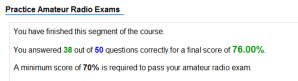
AWESOME! I just passed my very first Extra Class practice test. This means that I am doing well and am getting it down! I think the “Vidicon” rant post must have helped me! 😀
I passed with 76%, so that means I had a 3 question margin was all. That of course does not mean I am ready to take the actual exam, but at least I know my methods are working now. I have a little less than a month to go before I take the exam, so now I am going to try to take at least 2 practice tests per day until I leave for Dayton. That way I will know that I will have it down cold before I get there.
Progress! YEA!!!!
73! de Nick N9SJA
Extra Class: Improving! (Vidicons and thoughts about the exam)
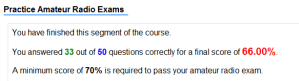 Well. I failed yet another Extra Class practice exam. However, I am improving. I constistantly now am scoring in the mid 60% range which means I am almost there though. 70% is required to pass, so I think I will have this down before I go to the Dayton Hamvention to take my exam.
So far, I have no real secret for studying. I have bought books, listened to audio by Gordon West WB6NOA, bought an online subscription to hamtestonline.com, and downloaded study guides. I find that most of these things have helped me learn the material to some degree, however none of them really explains why things work the way they do. For example, question E6E09 asks: “What type of amplifier device cosists of a small pill-type package with an input lead, an ouput lead and 2 ground leads? (Answer: “A monolithic microwave integrated circuit (MMIC)). But in all the materials that I have obtained, it just gives you the correct answer. No real information (not even a breif blurb) that explains what MMIC are or what they do. For that I guess we have google. 😉 I really believe that most of the material that I am learning is due to rote memorization more than any other learning technique. And why that is good I guess for me passing the exam, it really doesn’t teach me much other than learning what the answer is to a given question that I have read several times and memorized the answer. I find this a bit disappointing. Perhaps a class would be a better way to go as a instructor could get more in depth with the hows and why things work.
For anyone thinking about taking the Extra Class exam, I think you need to answer this question:
What do I really want from an Extra Class Amateur Radio License?
If the answer to this question is to just merely have the privledges of the license (operating in the Extra Class portions of the bands), then I would say rote memorization should be your study method. If you want to learn stuff and really understand radio, I would suggest seeking out an Elmer or going to some sort of class where you can be with experienced hams (especially old guys that were radio station or TV station engineers back in the 50’s and 60’s). 🙂
Let’s face it A LOT of the info on the Extra Class Amateur Radio exam is based on old technologies. There are several questions about antiquated technology such as CRTs,and vacuum tubes. One question, E6D01: “How is the electron beam deflected in a vidicon?” (Answer: “By varing the electromagnetic fields”), I was all “WTF is a vidicon!?!?!?!?” So I googled it up: From Wikipedia [http://en.wikipedia.org/wiki/Video_camera_tube#Vidicon] “A vidicon tube is a video camera tube design in which the target material is a photoconductor. The Vidicon was developed in the 1950s at RCA by P. K. Weimer, S. V. Forgue and R. R. Goodrich as a simple alternative to the structurally and electrically complex Image Orthicon.[citation needed] While the initial photoconductor used was selenium, other targets–including silicon diode arrays–have been used.”
Although interesting, I really don’t understand why questions like this are even on the test in the 21st century. It’s 2012 and most people don’t even have a CRT television in their homes anymore much less a Vidicon laying about. I am interested in the technology of long ago, and find it interesting, but I think these types of questions are frankly ridiculous. If you are interested in building a old radio or using a Vidicon, there are plenty of resources you can go too to find out more about those things. Hams will be more likely to get a computer web cam or other modern camera for SSTV, ATV or other ham application where they need to use a camera than an old video camera with a Vidicon tube.
I know that some would say that I am for dumbing down the exam, but they could not be further from the truth. And although there are a few questions about PSK31, and other digital modes, I would find it more relevant today to have more technical questions about computer technology on the exam. You will find more computers in Ham shacks today than you will find CRTs, vacuum tubes and Vidicons. Most hams use computers for station control, logging, digital modes, etc., so why not get rid of the antiquated stuff and put in some questions about how their computer works. (and if your a guy that is saying “well then that would be a computer exam, computers are used for all sorts of things” …well then I would counter with my CRT argument. They were mostly used for Television sets. You wouldn’t have said this is a “TV exam”. 😐
I know that this turned into a bit of criticism about the test and the VEC that puts in the questions, but if they want to attract younger blood to this hobby, they need to consider what I am saying about these old technolgies. Most new hams buy their shack anymore. And the stuff they buy is modern, microprocessor, computer interface able, and even network able gear. I doubt that many young hams are saying “Yeah, I’m going to build my radio with a Colpitts oscillator and send crappy CW to a guy with an ICOM 7800, because I am all about the old school technology.”
I enjoy learning about the old school stuff, don’t get me wrong, but I just don’t think it needs to be on this exam. Questions about more modern technologies need to be there.
If you really just want the license and don’t care about learning anything, I suggest not purchasing a darn thing. Just look at the free downloadable study guides on the internet, and take the free practice exam on QRZ.com continually unitl you memorize the questions and pass. (I know that is a horrible thing to say!!!) :s
If you want to learn and understand radio theory and engineering, find an old station engineer, an Elmer, and read a lot on the internet and from books. (Of course you can do this after you pass the Extra class exam – like I am going to do) I find that learning is the journey not the destination. I am also learning CW and have even made several contacts (even though they removed the CW tests from the requirements of getting an Amateur Radio License!)
On the plus side, the VEC does do a good job with the questions regarding procedures and policies. I think there should be more questions about that sort of thing. Maybe the LIDS on 14.313 would have turned out different if they understood the rules better. (I seriously doubt it…just making a crack here. Dickheads are dickheads regardless of passing tests, or getting licensed).
Am I right or wrong here? Tell me what you think in the comments.
In the meantime, I am going to keep studying so that I get my Extra Class license, and when I do get it, I am going to find me a damn Vidicon to hang on my wall and collect dust in tribute to this post. 😀
73! de Nick N9SJA
Indiana QSO Party – May 5th and 6th, 2012
 The Indiana QSO party is coming up! May 5-6, 2012!
I think I just may participate this year. More info can be found here: http://www.hdxcc.org/inqp/
Maybe I will see if some of my other Ham buddies want to do this and maybe we can set up a special station somewhere with several radios and antennas operating on different bands.
73! de Nick N9SJA
Extra Exam – Study
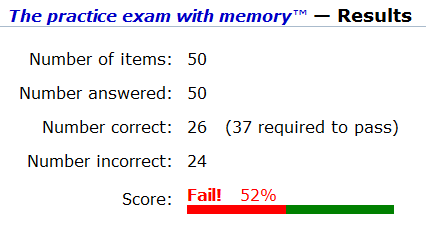 Today I took my first practice test for the Extra Class examination. I plan on studying now so that I can take my Extra Class exam and pass it when I go to the Dayton Hamvention in May. As you can see from my first practice test, I didn’t do so well (CALL IN THE FAIL! WHALE)
I am studying for the Extra Class exam using Hamtestonline.com, and also using a study guide that was made by Jack Tiley AD7FO. I think so far this is working fairly well even though I only got a 52% on my first practice test, I have only been studying for the past two days with diligence.
I used this same method to take and pass my General Class exam back in 2008, so as long as I spend at least an hour per day studying I should have no problem when the time comes to take my Extra at Dayton.
Taking an Amateur Radio examination at the Dayton Hamvention is free, however there is usually a bit of a wait since there are so many upgrading and potential new Amateurs taking the tests.
I will continue with my studies, but I would appreciate any motivational, test tips or other good advise you could provide me in the comments below. 🙂
73! de Nick N9SJA
HF Band Conditions
 K9XN
K9XN 