
Kenwood TS-830S Tuning Procedure
I created a video that shows how to tune the Kenwood TS-830S for transmit. This video would also cover some of the other Kenwood hybrid rigs as well, since the procedure is fairly similar. The idea for this video came from one of the viewers of my first Kenwood TS-830 video that I made on YouTube.
A video that shows how to tune up the Kenwood TS-830S
Enjoy!
73! de Nick N9SJA
K6PLR’s remote station and KC3MX’s streaming video
 Just had a nice QSO with Grant K6PLR from Carlsbad, CA. He was operating a remote station (the station was located somewhere in PA he said).
It was great to meet Grant and before the band faded out on us, I had a good conversation with him about his remote station, old radios, and antennas.
After I spoke with Grant, I decided to call CQ on 14.263.00 and Harry KC3MX came back to my call. He has a setup with streaming video of his shack!
You can check it out here when he’s on the air: http://radioodyssey.com/ROARS__-_KC3MX_Live.html.
Great station Harry, and thanks for the QSO!
73! de Nick N9SJA
Homebrew: The N1TEV Regen Build – Part 1
 Today I picked up some parts to start the build of my N1TEV regenerative receiver. Checking online I found that Far Circuits makes a board that is ready to go for this project. His website and ordering process are definitely old school. He really needs to make a better e-commerce web site. Basically ordering from Far Circuits sucks, but the boards are nice and I picked up two of them. One for Jeff N9IZ and one for myself.
I went by RadioShack today to get some of the parts. I couldn’t find all the parts locally, so I had to scavenge about a bit and look for some parts that I had lying around the shack. This ended up to be a good thing, because I had several of the capacitors lying about. Like a mondo 100V version of a .047 uF cap that really just calls for a 50V small cap. The legs of that cap were a bit thicker since it can handle double the voltage, so I had a bit of a struggle getting through the holes on the breadboard. RadioShack is really pretty expensive for parts, so if you have bits lying about I would suggest you use them.
I would say that I am about 40% done with this project. It took me about an hour to do this much, and that was with the scavenging about to find some of the caps and resistors. I had a blast soldering these components to the board. It was nice to smell the familiar scent of rosin and solder again if just for a little while.
On the plus side I found a great site to look up resistor color codes to find resistor values here. It is very simple but effective. I found another site that will tell you the values for those small disc caps on Elecraft’s page here.
Looks like I’m going to need more parts that I don’t have lying about so off to the internet for those. I need a variable capacitor, a good enclosure, knobs and miscellaneous goodies still. Jeff (N9IZ) sent me a link for a site for some great vernier turning dials that I think would be awesome for this project.
I plan on using a BNC connector for the antenna connector. I think that would be a good solid choice and I have a chassis mount one of those around I think.
RadioShack did not really have anything good in the way of enclosures so I stopped by another electronics store in town called Lafayette Electronic Supply, Inc. They have a great selection of stuff, but holy utility belt Batman are they EX-PEN-SIVE!!! The enclosure I liked was $40. $40!!! can you believe that for a empty metal enclosure? I thought that was just way too beaucoup expensive for that and will either look around online or make one from copper clad boards which a lot of people have done building regens like this. I walked out of Lafayette Electronic Supply without buying a thing. For the prices they charge there you would have to give blood or take out a loan to build something. I could have bought 4 AM radios for the price of the enclosure alone. Horsehockey! as Col. Potter once said.
The build was fun, but all good things must come to an end, at least for today. Stay tuned for Part 2! I’m really having fun building this and it is going to be awesome once I get to hear my first scratchy reception of a HAM or SW broadcaster.
73! de Nick N9SJA
Homebrew: N1TEV Kitchin Regenerative Reciever
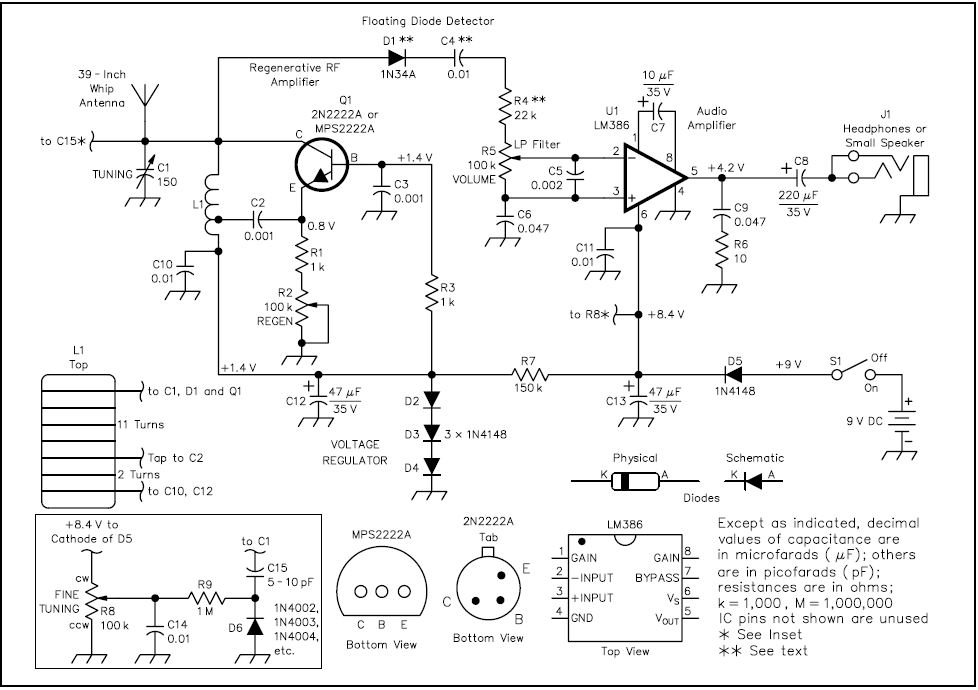 After speaking with my good friend Jeff (N9IZ), he got me interested in building a regenerative receiver. Jeff shared with me several YouTube links that have receivers like this that many hams and experimenters have built.
This particular receiver design comes from Charles Kitchin N1TEV. His design is a modification of a classic design that dates back to the 1920’s. The main modification is the use of the LM386 audio amplifier IC to give it a little better volume control, the use of 2N2222A transistors (instead of tubes), and the diodes that go to ground to improve regeneration.
When I decided that I would like to build a regenerative receiver and researched different designs, I settled on this one because I have heard that it is the most successful of the designs.
Originally detailed in the September, 2000 issue of QST magazine, the article that describes the design and details the circuit is available online here. There is a comprehensive parts listing complete with RadioShack part numbers for almost all components with the exception of the variable capacitor that is used for tuning (air-dielectric variable 150-350 pF). However those variable caps should be fairly easy to find, and most hams may even have one lying about or in something that could be scavenaged (like another old radio 😉 ).
This will be a multi-part build so, once I get the parts in I will document and maybe even make a video of the build. I think Jeff is going to build one with me, so that should be a lot of fun as we curse our way through the problems of the build and getting the thing to work correctly. I plan on making mine work on the 40m band. I thought that would definitely be more useful than another AM broadcast band radio, and then who knows, maybe Ill make a 40m transmitter as well. The regenerative receivers are pretty cool since they do not need a BFO or other circuitry to tune in AM, SSB or CW signals well. Just a touch of the regeneration control will help tune all signals in loud and clear. Well, im off to order the parts to put this together, so see you soon!
73! de Nick N9SJA
1951 Vibroplex “Lightning” Bug!
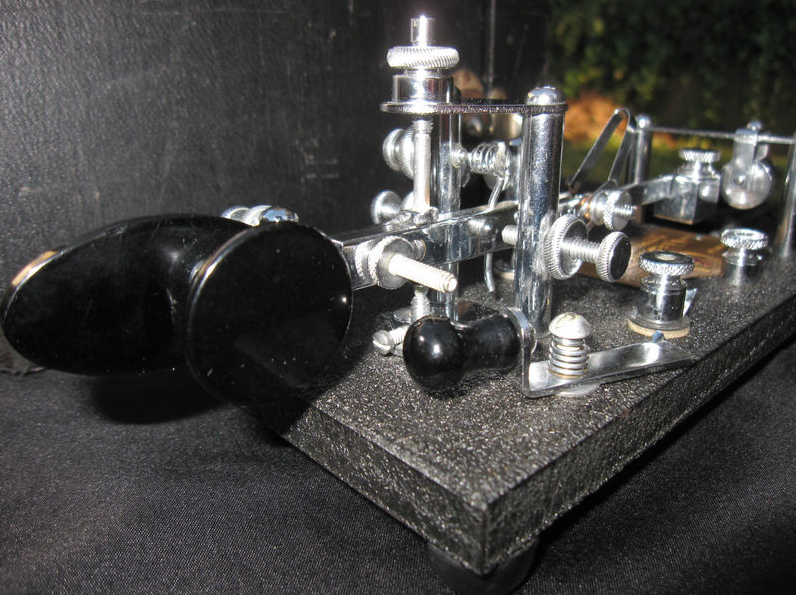 WOW! I just got this from an online auction. It is a 1951 Vibroplex “Lightning” bug! I really wasn’t looking for a bug, but when I saw this and it was going for such a good price, I decided to watch it.
Since I’m not really great at CW, I’m sure I will not get the benefit from a Vibroplex like a CW expert would, but its totally cool old school design I just couldn’t pass up. It also came with a box that is leather on the outside and padded with green felt on the inside.
This bug was left in this box for many years and since it was protected so well, it looks new.
I have a Bencher iambic paddle I usually use with the IC-7600, and have gotten fairly good at using it, but never have used a Vibroplex. I know these require some attention with the setup to make them work well. Other hams have told me that there is a lot of tweaking that can and should be done to make a Vibroplex bug work well, so I will need to learn how to do that.
(UPDATE) I just found this awesome vid on YouTube from Jim WB8SIW that shows how to set up a Vibroplex bug properly! Very nice video:
73! de Nick N9SJA
Late Night R.H.C. Propaganda Listening

Using my SDR-IQ receiver I tuned in to “DX’ers Unlimited with Arnie Coro CO2KK”. It is actually a very interesting 10 minute or so program focusing on Amateur Radio and shortwave listening. It is flanked by so called “news” which largely portrays the United States of America falsely and in a bad overall light. Mr. Coro is instersting and friendly on the air. Tonight’s topic was TEP (Trans-Equatorial Propagation). He gave a brief description of what it was and how it worked.
I sometimes listen to Radio Havana Cuba just for a laugh. The station and the announcers rail against the USA and every now and then there is a commercial like advertisement to “Free the Cuban Five”. The Cuban Five were spies that were caught in the US several years ago. More on that here in case you are curious. The way that they portray the US as evil is quite hilarious.
It wont be too much longer until Cuba is free I believe. When Fidel Castro and his brother finally pass on, communism and totalitarianism will die with them. The government of Cuba will not survive the death of those two brothers and the light that is increasingly shown on the Cuban government from free nations and true patriots from Cuba.
The signal that is beamed from RHC is very strong. S9+30dB, so picking it up shouldn’t be a problem for most people in the eastern USA. Just a modest wire antenna would work just fine to receive the 49m band 6.000 MHz signal. There seems to be also a high pitched sound that is transmitted with the AM carrier on the upper sideband of the carrier. I used a filter to adjust it out, otherwise it would be a bit annoying to listen to.
Well as they say for the sign off for RHC…”I will see you mañana!”
73! de Nick N9SJA
Ham Shack 2.0

I just straitened up my shack (it was a total mess!) and re-arranged everything. Now with the shack tidy, I can enjoy using all my equipment without tripping over random bits of equipment, wires, and books.
It’s hard to believe that this shack got so messy. It’s amazing what you accumulate over time. I’m not usually a pack rat or horder, but I sure amassed a bunch of radio junk.
I took some pictures of the new shack layout and posted them on my Flickr page. Hopefully I will be more diligent this time on keeping things neat and tidy down here…
Here are some other photos I snapped up after my tidy up:
 Row Of Radios (just to the left of the main operating position).
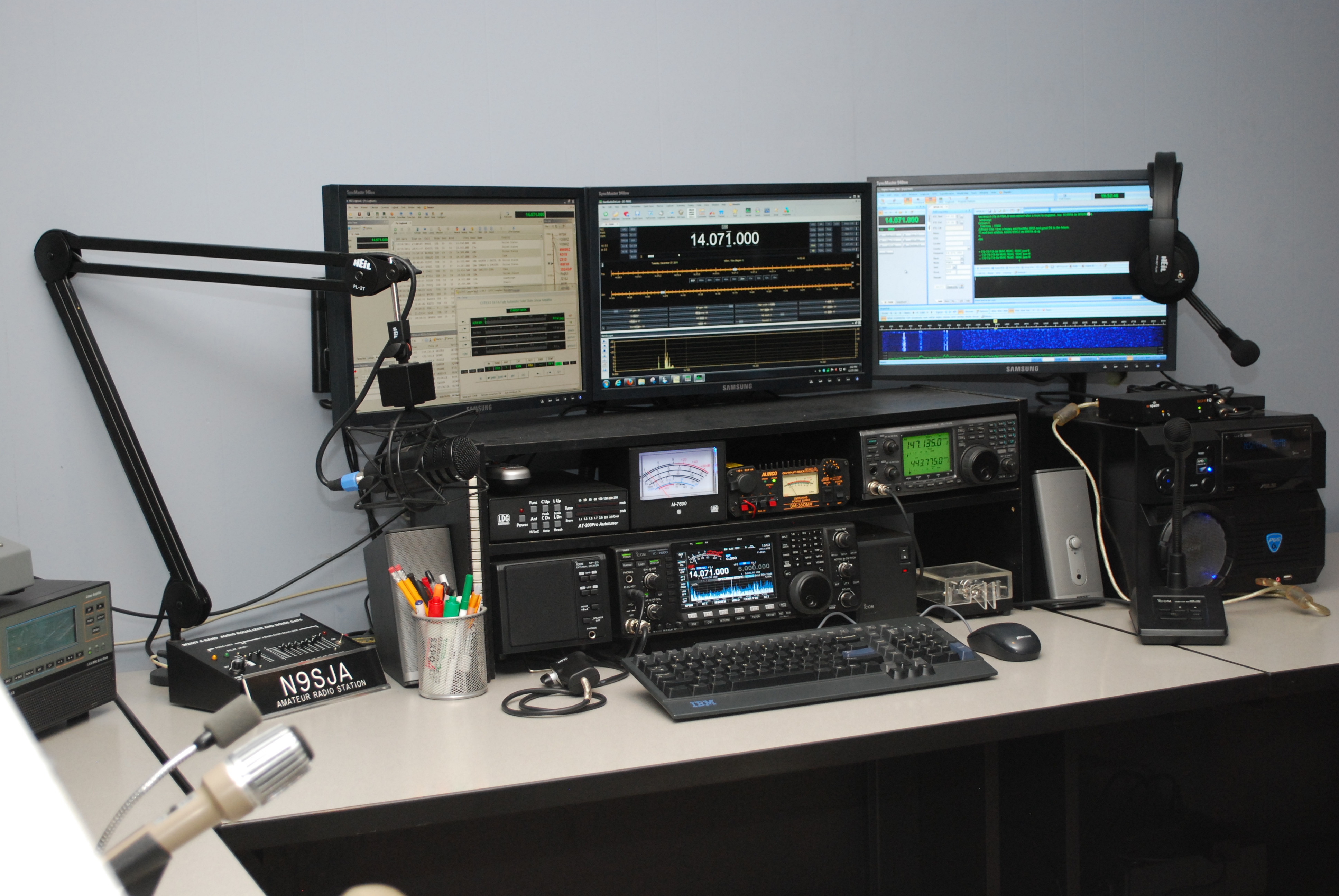 Main Ops.
 Kenwood TS-830S & Ten-Tec Omni VI.
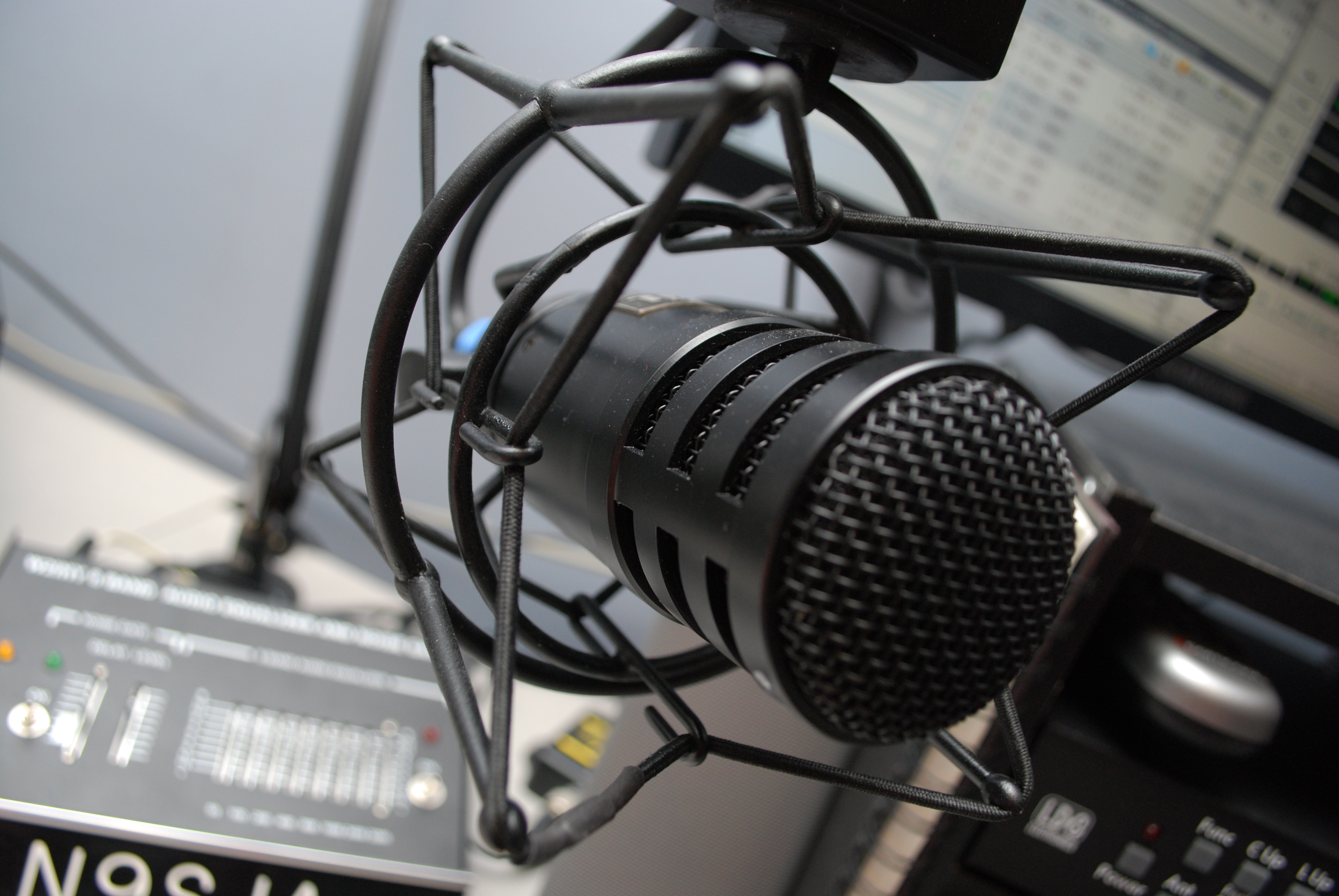 Heil PR-781 Microphone.
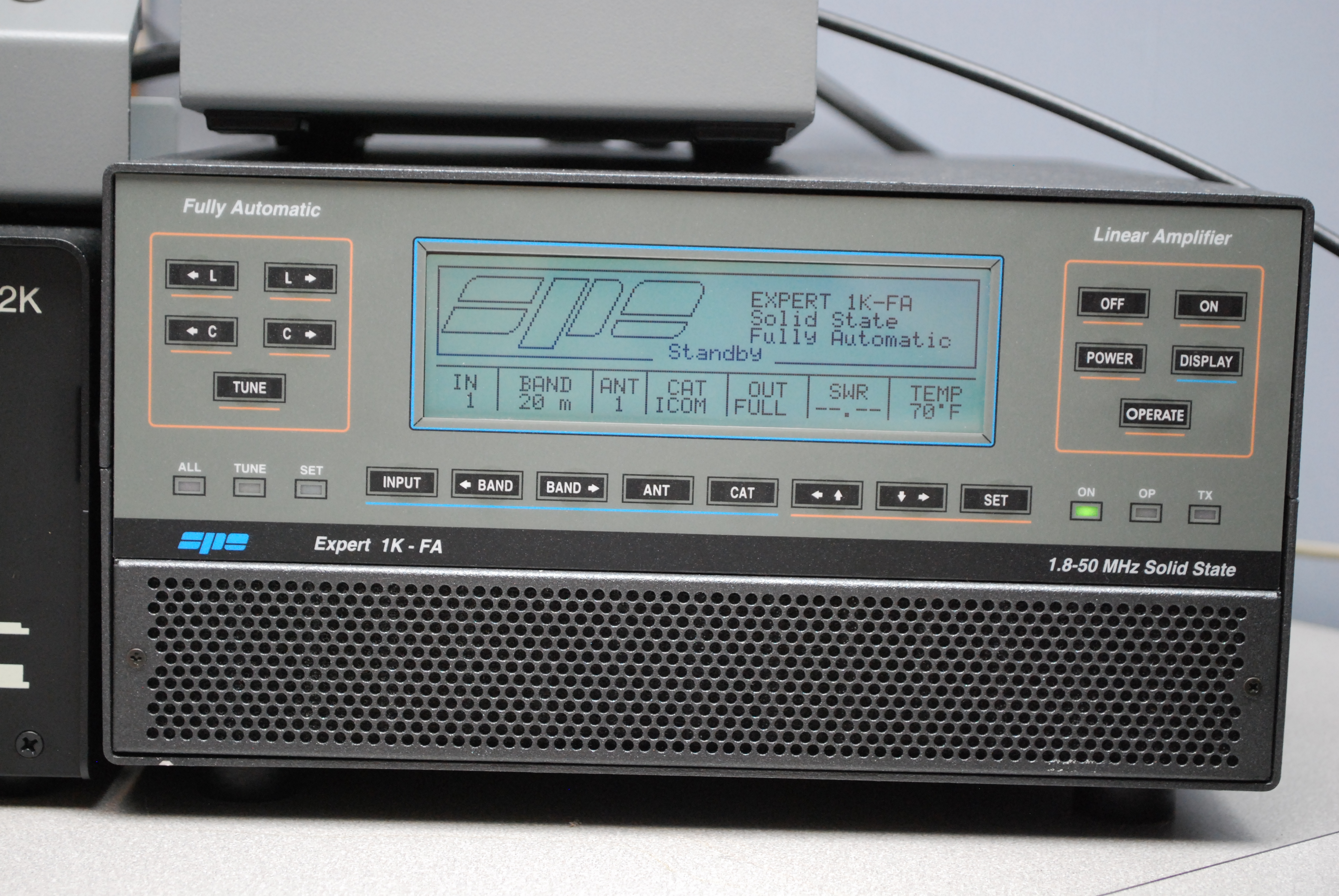 SPE Expert 1K-FA Solid State Linear Amplifer (1000 Watts)
I posted more pics of my shack on Flickr. If your curious, go and check them out.
73! de Nick N9SJA
Icom IC-735
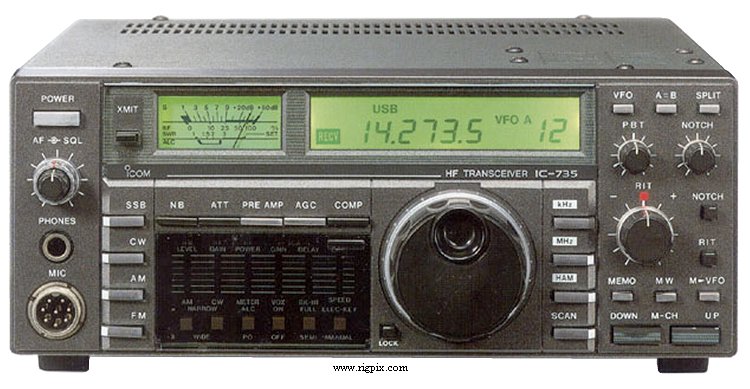 Today I picked up a nice little gem for a great price. The Icom IC-735. This little radio doesn’t have many frills but works very well.
The radio came from the estate of SK Ham, Herman Huffman KE9YZ, that was very active with MARS. The radio has been modified for MARS use, but since I am not affiliated in MARS, I cannot use those frequencies.
It was nice to meet with his family and although I did not know Herman, I heard some nice stories about his love of Amateur Radio and MARS.
It was a little dusty, but no marks and after a wipe down with a lint free cloth and windex, the radio looks brand new. It even still has the little plastic door on it that covers the sliding pots for mic gain, rf power, and vox settings. Kind of reminds me of an equalizer or something looking at those sliding pots with the horizonal line markings on the chassis.
This particular radio is microprocessor controlled solid-state, and has the following features:
- Passband Tuning Control
- Dual VFO’s and a split frequency operation
- Adjustable Notch Filter Control
- RIT (receive iincremental tuning control)
- 12 Memories
- AGC control (fast-slow)
- Noise Blanker
- Preamplifier (10dB)
- Speech Compressor
- VOX
- CW, SSB (USB and LSB), AM, and FM
- Narrow filters for AM and CW
- Scan feature
- Built in electronic keyer
- 100 watts on SSB and FM, 40 watts AM
- General Coverage reciever
I was just going to turn around and sell this at Dayton, but I think this one is too nice to let go.
73! de Nick N9SJA
Ten-Tec Omni VI LED bulbs
I have had a few e-mails from other Amateurs wanting to know where I bought the LED bulbs for my Omni VI.
Here is a direct link to the supplier and part: http://www.bulbtown.com/LM1006MB_W_LED_MINIATURE_BULB_BA9S_BASE_p/lm1006mb-w.htm
73! de Nick N9SJA
N9IZ’s Blog
 My buddy Jeff N9IZ just built a new Amateur Radio blog site. He really worked hard on it and even built his own web server and installed WordPress himself! Now he is blogging about all of his amateur radio adventures (or misadventures depending on the day!).
Check out his site here: http://n9iz.dyndns.org/wordpress
Jeff’s site is really good and he always has something interesting to post. Whether your keeping up with his projects like the Heathkit DX-60A restoration, or DX he is working on his Flex 5000A and K4KIO Hex Beam, there is always something good to read about there.
So, what are you waiting for? Go check out his blog and leave him a few nice comments. (That is after you are done reading my blog! 😉
73 de Nick N9SJA
HF Band Conditions
 K9XN
K9XN 